Commandez en ligne, retrait gratuit en librairie

Cosmos
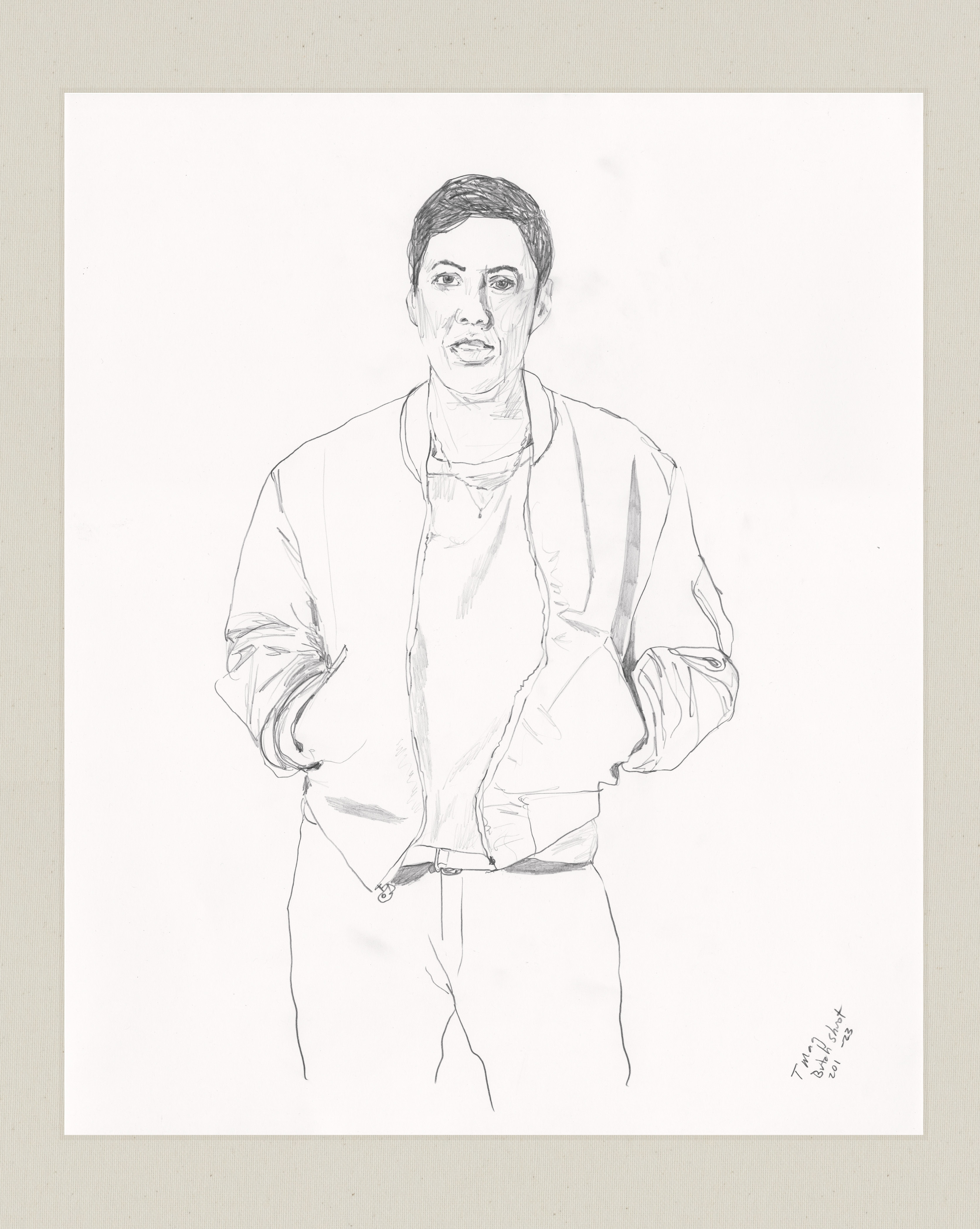
In 2020 Collier Schorr began drawing from photographs she had made of the artist Nicole Eisenman, a solitary practice that had its roots in her fascination with the doppelganger and the possibility of seeing one’s face in another. This volume, sequenced in Schorr’s unmistakable narrative style, brings together a wide array of drawn portraits, selfies, and self-portraits, both staged and candid, in recognisable spaces and emerging from the blank page. Other artists and Eisenman's teenage daughter make appearances, setting up a sparsely occupied world. In one image, the cover of a Susan Sontag biography floats like a spectre, uneasy in its proximity to the queer figures asserting themselves between the pages. Schorr sees these drawings as works that think about photography and escape it simultaneously. A photograph will always share authorship between photographer and subject, while a drawing registers a different form of physical attention and collaboration. It engages bodies and space, and creates ambiguity where photography is conclusive – through a loss of concrete setting, or an absence of age. The porous worlds of queer culture operate much more closely than those of photography and painting. COSMOS explores the way these two figures inhabit many orbits, existing as mortals as well as images in their work and their communities. With an essay by Jennifer Higgie
À propos de ce livre
In 2020 Collier Schorr began drawing from photographs she had made of the artist Nicole Eisenman, a solitary practice that had its roots in her fascination with the doppelganger and the possibility of seeing one’s face in another. This volume, sequenced in Schorr’s unmistakable narrative style, brings together a wide array of drawn portraits, selfies, and self-portraits, both staged and candid, in recognisable spaces and emerging from the blank page. Other artists and Eisenman's teenage daughter make appearances, setting up a sparsely occupied world. In one image, the cover of a Susan Sontag biography floats like a spectre, uneasy in its proximity to the queer figures asserting themselves between the pages. Schorr sees these drawings as works that think about photography and escape it simultaneously. A photograph will always share authorship between photographer and subject, while a drawing registers a different form of physical attention and collaboration. It engages bodies and space, and creates ambiguity where photography is conclusive – through a loss of concrete setting, or an absence of age. The porous worlds of queer culture operate much more closely than those of photography and painting. COSMOS explores the way these two figures inhabit many orbits, existing as mortals as well as images in their work and their communities. With an essay by Jennifer Higgie
Publié chez MACK en août 2024, cet ouvrage fait partie de nos recommandations au rayon Romans.
Le mot du libraire
Chaque livre présent dans notre librairie a été lu ou parcouru par notre équipe. Ce titre nous a particulièrement marqués pour sa qualité d’écriture et la justesse de son propos. N’hésitez pas à passer à la librairie : nous serons heureux d’en discuter avec vous.
Souvent achetés ensemble

Ce qu’ils en ont pensé
Aucun avis pour le moment — soyez le premier à donner le vôtre.
Connectez-vous pour laisser un avis.
Une question sur ce livre ?
Un libraire lit votre message et vous répond — sur Cosmos comme sur ce que vous pourriez lire ensuite.
Une question fréquente, à compléterVotre adresse sert uniquement à vous répondre. Elle n’est ni affichée, ni transmise : la librairie répond par la messagerie Vitaville.
0/2000